
sensors
E2B-M12KS04-M1-B1 2M Inductive Proximity Sensor M12 4mm M12 Connector Shielded
SKU: E2B-M12KS04-M1-B1 2M
View Product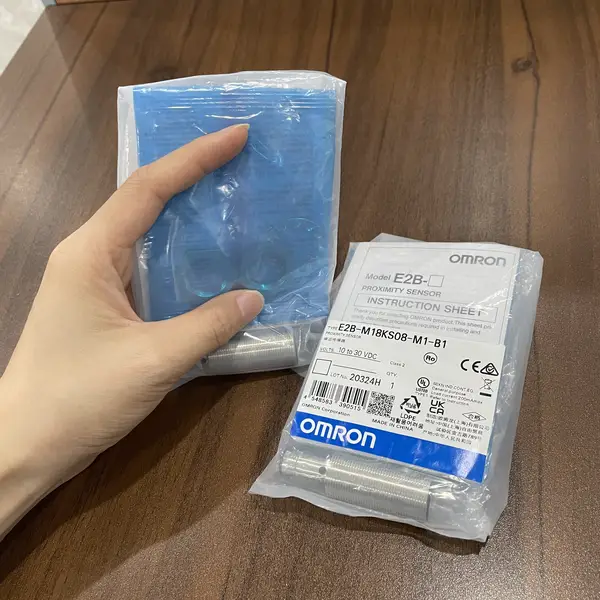
USD 12.00
Omron E2B-M18KS08-M1-B1 is an M18 nickel-brass inductive proximity sensor with 8mm shielded sensing range, PNP NO output, M12 connector, IP67 — short-body 59mm length.
This item is available for immediate shipment from our warehouse.
Contact for pricing, bulk discounts, and shipping
The E2B-M18KS08-M1-B1 is a short-body M18 inductive proximity sensor in Omron's E2B economy line. The model code breaks down as: E2B = family, M18 = 18mm threaded body, K = short body, S = shielded, 08 = 8mm sensing distance, M1 = M12 connector, B1 = PNP normally-open output. Inductive proximity sensors detect metal objects without contact. The sensor generates an electromagnetic field; when a metal target enters the field, eddy currents in the target reduce the field's amplitude, and the sensor detects this and switches its output. Detection works through non-metallic materials (wood, plastic, cardboard), so the sensor can be hidden behind a panel or inside a fixture as long as the target is in front of the sensing face. The 8mm sensing distance is the 'quasi-flush' spec — for an M18 shielded sensor, the rated range is 8mm with a standard 18x18x1mm mild steel target. The non-shielded variant (E2B-M18KN10-M1-B1) gives 10mm but requires more side-clearance around the sensing face. The 8mm shielded is the most common spec for OEM machinery — enough range for typical mounting distances, compact installation footprint. On the wiring side, the M12 connector is the 4-pin industrial standard. Pin 1 = brown (12-24 VDC), pin 3 = blue (0V), pin 4 = black (PNP output), pin 2 = not used (or in some models used for NO/NC selection). The 200mA output current is sufficient to drive a PLC input directly, a small relay, or a 24V indicator light. The 1 kHz max switching frequency is the upper limit for counting fast-moving targets — adequate for most conveyor and feeder applications, but for very high-speed counting (above 1 kHz events) look at the E2E series with 5 kHz or the E2A with 25 kHz. The brass, nickel-plated housing is the right pick for industrial environments. Compared to the plastic E2A family, the E2B brass survives: - Coolant and cutting fluid splash in machining cells - Mechanical impact from dropped tools or parts - Solvent and cleaning chemical exposure in food/pharma washdown - Higher operating temperatures (the E2B is rated to 70°C ambient) On the mechanical side, the 59mm overall length is the short-body variant — useful for installations with limited depth behind the mounting panel. The long-body E2B-M18LS08-M1-B1 (also 8mm sensing) is 79mm overall, preferred when you need more thread engagement or a more stable mount. Common use: part presence detection on conveyors and feeders, end-of-stroke confirmation on cylinders, position feedback on machine slides, tool position verification in machining, cap-and-bottle detection on packaging lines. The M18 thread with two knurled nuts is the most common industrial form factor for proximity sensors worldwide — fits standard 18mm mounting holes.
| Model | E2B-M18KS08-M1-B1 |
|---|---|
| Series | E2B |
| Size | M18 (18mm diameter) |
| Sensing Distance | 8mm (shielded) |
| Output Type | NPN |
| Supply Voltage | DC12-24V |
| Connection | M12 connector |
| Protection | IP67 |
| Mounting | Flush (shielded) |
| Load Current | 200mA |
Explore related Omron models often viewed alongside this product.
sensors
SKU: E2B-M12KS04-M1-B1 2M
View Product
sensors
SKU: E2B-M12KS04-WZ-B1
View Product