
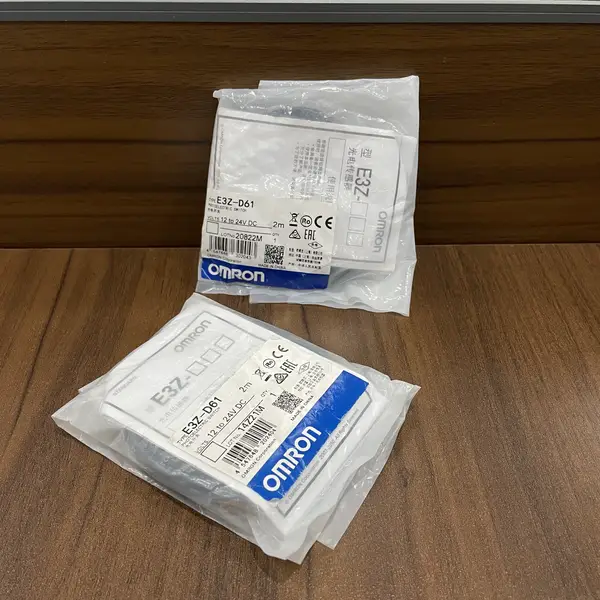
Omron E3Z-D61 — Industrial Sensor
SKU: E3Z-D61USD 16.00
Compact diffuse-reflective photoelectric sensor in 20 × 11 × 31 mm cuboid housing, 100 mm range on white paper, infrared LED 860 nm, NPN open-collector output, pre-wired 2 m oil-resistant PVC cable, IP67, Dark-ON/Light-ON selectable.
1-Year Warranty
Full manufacturer warranty
Global Shipping
Worldwide delivery available
Genuine Omron
100% authentic product
Ready to Ship
Usually ships within 24h
In Stock
This item is available for immediate shipment from our warehouse.
Contact for pricing, bulk discounts, and shipping
Product Overview
The E3Z-D61 is Omron's compact 100 mm diffuse-reflective photoelectric sensor in the E3Z family, the NPN-output sibling of the already-done E3Z-D82 (PNP). It uses an infrared LED (860 nm) emitter and a photodiode receiver in a small 20 × 11 × 31 mm cuboid housing, designed for short-range object detection where the sensor can be mounted close to the target. Typical applications: small-parts presence detection on a feeder bowl, label presence on a packaging line, cap-on-bottle detection on a bottling line, paper-edge detection on a printer, and conveyor-belt object counting.
Diffuse-reflective sensing principle and target effects
Diffuse-reflective sensors (also called 'diffuse' or 'proximity') emit a light beam toward the target and detect the light that is scattered back from the target's surface. Unlike retro-reflective (E3Z-R61 2M, also in our catalog) which uses a reflector, or through-beam (E3Z-T61 / T81) which uses a separate emitter + receiver pair, diffuse-reflective senses the target directly. The trade-off: sensing distance depends on the target's colour and surface finish. A 100 mm sensor rated on white paper (90% reflectivity) will only detect a black paper target at ~30-40 mm (30-40% of nominal). A polished metal target can be detected at 110-120% of nominal.
E3Z-D61 vs E3Z-D62 vs E3Z-D81 vs E3Z-D82
The E3Z D-family is a 2×2 matrix of range × output: D61 / D66 = 100 mm NPN (pre-wired 2 m / M8 connector) D62 / D67 = 1 m NPN (pre-wired 2 m / M8 connector) D81 / D86 = 100 mm PNP (pre-wired 2 m / M8 connector) D82 / D87 = 1 m PNP (pre-wired 2 m / M8 connector) Pick E3Z-D61 (this SKU) for 100 mm range with NPN output, pre-wired 2 m cable. Pick D81 for PNP (European wiring standard, where sensors source current).
NPN wiring and Dark-ON / Light-ON mode select
NPN output means the sensor's output transistor sinks current to ground when active. Wiring: brown wire to +24 VDC, blue wire to 0 V (GND), black wire to the PLC input. The PLC input is pulled up internally (or via an external resistor if the input unit is NPN-sinking). When the sensor detects the target, the output transistor closes between the black output wire and the blue ground wire, sinking current and pulling the input low. For NPN-style PLCs (Japanese standard, where inputs sink current), the input unit's COM is wired to +24 VDC.
Key Features
- Compact diffuse-reflective photoelectric sensor in 20 × 11 × 31 mm cuboid housing
- Sensing distance: 100 mm
- Light source: Infrared LED — invisible to the eye, no visual indication on target
- Differential distance: 20% max of sensing distance
- Response time: 1 ms max
- Output: NPN open-collector, 100 mA max load current
- Dark-ON / Light-ON mode selectable via white wire
- Supply voltage: 12 to 24 VDC ±10%
- SKU: E3Z-D61
- Series: E3Z Compact Photoelectric Sensor with Built-in Amplifier
- Voltage: 12 TO 24 VDC
- I/O: 100 I/O
Best-Fit Applications
- Small-parts presence detection on a vibratory feeder bowl — the E3Z-D61 detects whether the next part has been released from.
- Label presence detection on a packaging line — the E3Z-D61 detects the leading edge of a label on a label.
- Cap-on-bottle detection on a bottling line — the E3Z-D61 detects whether a bottle has a cap applied at the cap-torque.
- Paper-edge detection on a printer or paper-converting machine — the E3Z-D61 detects the paper edge for alignment, with the 20.
Buying Checklist
- Pick E3Z-D61 for 100 mm diffuse-reflective, NPN, pre-wired 2 m — short-range object detection with NPN output
- Pick E3Z-D62 for 1 m diffuse-reflective NPN — longer range with larger beam spot, more sensitive to target colour
- Pick E3Z-D81 for 100 mm diffuse-reflective PNP — same range as D61 but PNP output for European wiring standard
- Pick E3Z-D82 for 1 m diffuse-reflective PNP — longer range with PNP output
- Pick E3Z-D66 for 100 mm diffuse-reflective NPN with M8 connector — quick-disconnect for modular tooling
- Pick E3Z-D86 for 100 mm diffuse-reflective PNP with M8 connector — PNP + M8 connector
Technical Specifications
| Model | E3Z-D61 |
|---|---|
| Series | E3Z Compact Photoelectric Sensor with Built-in Amplifier |
| Type | Diffuse-reflective (proximity), 100 mm range, NPN, pre-wired |
| Sensing Method | Diffuse-reflective (no reflector needed, target acts as reflector) |
| Sensing Distance | 100 mm (white paper 100 × 100 mm); black paper ~30-40 mm; shiny metal ~110-120 mm |
| Light Source | Infrared LED (860 nm), 4-element |
| Differential Distance (Hysteresis) | 20% max of sensing distance |
| Response Time | 1 ms max (operate and release) |
| Output Type | NPN open-collector, 100 mA max load current |
| Output Operation Mode | Dark-ON / Light-ON selectable (via white wire connection) |
| Supply Voltage | 12 to 24 VDC ±10% (ripple 10% p-p max) |
| Current Consumption | 30 mA max |
| Operating Temperature | -25 to +55 °C |
| Storage Temperature | -40 to +70 °C |
| Mounting | 2 × M3 screws on housing flanges, or 1 × M3 through-bolt; optional E39-L40 L-bracket |
Resources & Downloads
FAQ for E3Z-D61
What's the difference between E3Z-D61 and E3Z-D62?
Both are diffuse-reflective NPN-output photoelectric sensors in the E3Z family with the same 20 × 11 × 31 mm cuboid housing and pre-wired 2 m cable. The difference is the sensing distance: D61 (this SKU) has 100 mm range (rated on white paper 100 × 100 mm), D62 has 1 m range.
How do I wire the E3Z-D61 to a CJ1W-ID211 input?
Wire the E3Z-D61's brown wire to +24 VDC supply, blue wire to 0 V (GND), and black wire to the CJ1W-ID211 input terminal. The CJ1W-ID211's COM terminal must be wired to +24 VDC (not to 0 V) to accept NPN sinking signals.
What's the difference between Dark-ON and Light-ON modes on the E3Z-D61?
Dark-ON mode (white wire left open or tied to +24 VDC): the sensor output is ON when no light is received from the target — i.e., when the target is absent. This is the fail-safe default for most industrial applications because a wire break in the sensor output or a power loss to the sensor results in the same 'no signal' state as a target absent.
Can the E3Z-D61 detect black or shiny metal targets?
The E3Z-D61's 100 mm sensing distance is rated on white paper 100 × 100 mm. For black paper targets (5-10% reflectivity), the detection distance drops to ~30-40 mm (30-40% of nominal) — the sensor can still detect black paper but only at 1/3 of the rated range. For polished metal targets (80-95% reflectivity), the detection distance increases to ~110-120 mm (110-120% of nominal) — the sensor detects polished metal slightly beyond the rated range.
Similar Products
Explore related Omron models often viewed alongside this product.