
Omron safety systems Distributor | Genuine In-Stock SKUs
Omron safety systems Parts with Fast Lead-Time Support
This safety systems page includes genuine Omron models selected for industrial reliability and easier sourcing.
Need help choosing the right SKU? Share your application details and we can recommend matching options quickly.
Popular Series and Buying Notes
28 products available in this category.
Browse All 12 SKUs in safety systems
Why Choose Omron safety systems?
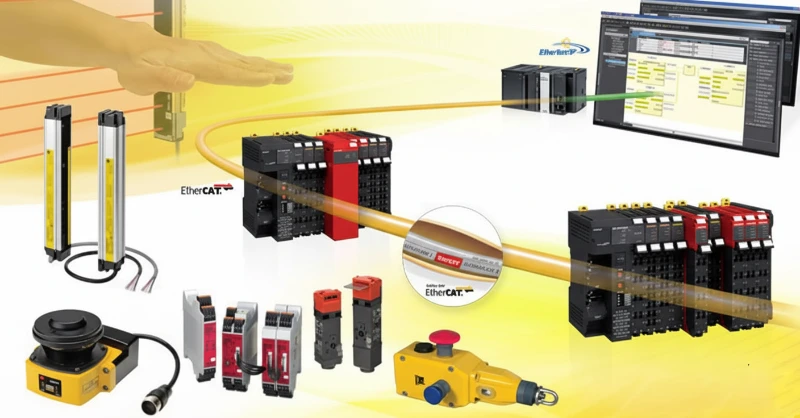
Omron's safety systems provide comprehensive protection for personnel and machinery, ensuring compliance with global safety standards without sacrificing productivity. From individual components to fully integrated solutions, our systems are designed to create a safer, more efficient manufacturing environment.
- A complete portfolio including safety controllers, light curtains, switches, and relays
- Certified to meet international safety standards like ISO 13849-1 and IEC 62061
- Flexible and scalable solutions that adapt to any machine size or complexity
- Advanced diagnostics to minimize downtime and simplify troubleshooting
- Seamless integration with standard automation systems for cohesive control
- Innovative designs that enhance operator usability while ensuring maximum protection
Frequently Asked Questions
What safety category do I need for my machine?
Safety categories (ISO 13849-1): Category B: Basic safety, no specific requirements. Category 1: Well-tested components, suitable for low-risk applications. Category 2: Periodic monitoring, for medium-risk. Category 3: Redundant channels with monitoring, for high-risk (most common for industrial machinery). Category 4: Highest level, fault-tolerant, for very high-risk (presses, robots). PL (Performance Level) a-e corresponds to categories. Most machines require Category 3/PL d or Category 4/PL e for safety circuits. Consult risk assessment.
What's the difference between safety relays and safety controllers?
Safety relays (G9SA, G9SB): Fixed functionality, pre-configured for specific applications (E-stop, gate monitoring). Simple wiring, cost-effective for single functions. No programming required. Safety controllers (G9SA-301, NX-SL): Programmable, flexible configuration, multiple safety functions in one unit. Better for complex systems with multiple safety devices. Easier troubleshooting with diagnostics. Choose safety relays for simple applications (1-3 functions), controllers for complex systems (5+ safety devices, multiple zones).
Can I wire multiple E-stop buttons to one safety relay?
Yes, multiple E-stop buttons can be wired in series to a single safety relay input. This is common practice. Important considerations: 1) All E-stops must be normally closed (NC) contacts, 2) Wire in series (daisy-chain), 3) Maximum number depends on relay input capacity (typically 10-20 E-stops), 4) Consider voltage drop for long cable runs, 5) Each E-stop should have positive opening action. For large machines with many E-stops, consider safety controllers with multiple zones for better diagnostics.
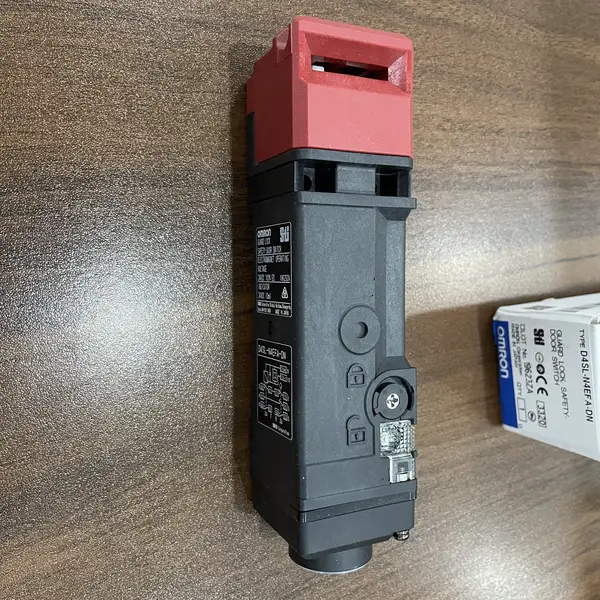
What's the difference between D4BL and D4BS safety door switches?
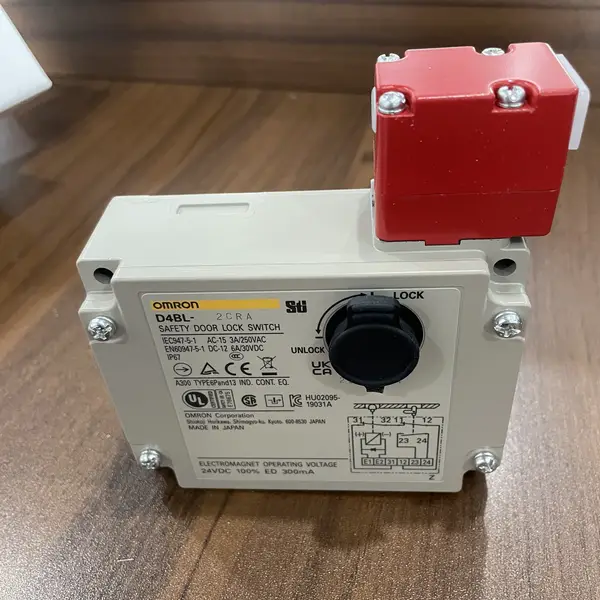
D4BL: Safety door switch with guard lock (solenoid release). Locks guard during machine operation, prevents access until machine stops. Required when hazard continues after stop command (spinning spindle, robot motion). D4BS: Basic safety door switch without lock. Monitors guard position but doesn't lock. Suitable when hazard stops immediately (gravity fall, quick-stop). Choose D4BL for Category 4 applications with time-delay hazards, D4BS for immediate-stop hazards.
Do safety light curtains require a safety relay?
Yes, safety light curtains must connect to a safety relay or safety controller. The safety relay: 1) Monitors light curtain status, 2) Provides redundant shutdown, 3) Monitors for faults (wire break, contact weld), 4) Ensures safe restart. Some light curtains have built-in safety outputs (OSSD) that can directly control contactors, but a safety relay is still recommended for: external device monitoring (EDM), manual reset function, integration with other safety devices (E-stops, gates). Always follow light curtain manufacturer's recommendations.
What's direct opening action and why is it required for safety?
Direct opening action: NC contacts are opened by direct mechanical force from actuator, not by spring. Even if contacts weld together, the actuator physically forces them apart. Required by EN 50205 for safety relays and safety switches. Ensures safety function even with contact weld. Identified by specific symbol on device. All safety-rated devices (E-stops, safety relays, safety switches) must have direct opening action on NC contacts. Never substitute with standard relays for safety circuits.
How do I reset a safety circuit after an E-stop?
Safety circuits require manual reset after safety function activation: 1) Identify and clear the fault (release E-stop, close guard), 2) Press reset button (on safety relay or remote reset), 3) Safety relay checks all inputs are safe, 4) Outputs re-energize, machine can restart. Automatic reset is NOT permitted for safety circuits (except specific applications with risk assessment). Reset button must be: outside hazard zone, clearly visible, protected from accidental operation. Some safety relays support monitored manual reset (checks reset button wiring).