
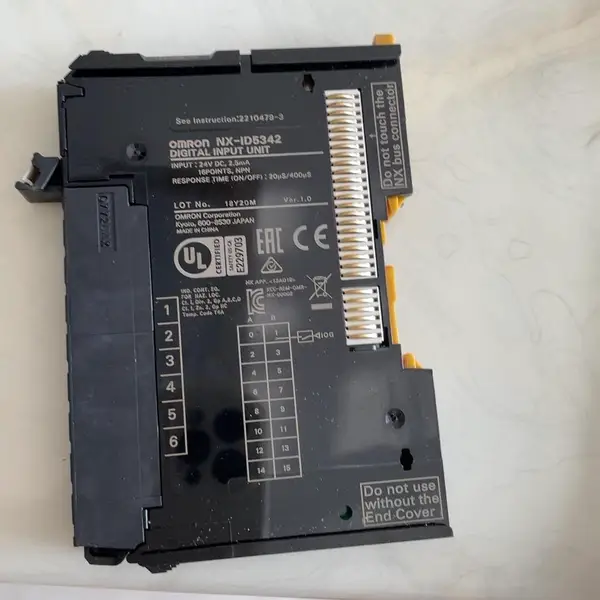
Omron NX-ID5342 — 16-Point NPN Digital Input
SKU: NX-ID5342USD 41.00
Omron NX-ID5342 is a 16-point NPN digital input unit for the NX-series EtherCAT I/O bus — 24 VDC, 0.02-0.4 ms response, 12 mm wide, screwless push-in connector.
1-Year Warranty
Full manufacturer warranty
Global Shipping
Worldwide delivery available
Genuine Omron
100% authentic product
Ready to Ship
Usually ships within 24h
In Stock
This item is available for immediate shipment from our warehouse.
Contact for pricing, bulk discounts, and shipping
Product Overview
The NX-ID5342 is the 16-point NPN digital input unit in Omron's NX I/O family. It mounts on the right side of an NX102 / NX1P2 / NJ501 CPU, or on an EtherCAT coupler for remote I/O drops. Each of the 16 inputs reads a 24 VDC digital signal and reports it to the controller over the NX bus. The '53' in the model code identifies the unit as 16-point NPN at standard speed; the '42' identifies the screwless push-in terminal block. So this is the high-density 16-point variant. For 8-point density in the same series, look at the NX-ID4342 (NPN, 8 points) or NX-ID4442 (PNP, 8 points). For PNP 16-point, the sibling is the NX-ID5442 — same footprint, opposite polarity. The input refresh rate is selectable: Synchronous I/O refreshing locks the input scan to the EtherCAT cycle (deterministic, used for high-speed interlocks) at 20 μs, or Free-Run refreshing scans at the unit's own pace (up to 400 μs) for general-purpose inputs. For most machine safety circuits, use Synchronous mode; for non-critical status inputs, Free-Run is fine and frees EtherCAT bandwidth. The 12 mm width and screwless push-in terminals make the NX-ID5342 a strong choice for retrofit projects where panel space is limited. The push-in terminals accept solid wire, ferruled stranded wire, or standard stranded with a push-in release tool (the same XW4Z-001B tool used elsewhere in the NX family). No screw torque to manage, no loosening from thermal cycling. On the wiring side, the common terminal (pin 17 / 'C' row) connects to the 24 VDC common — the polarity depends on whether you're using NPN (sinking) sensors that pull to 0V, or sourcing PNP sensors. For PNP inputs, use the NX-ID5442 instead. The rated input voltage is 24 VDC ±10%; inputs are optically isolated from the NX bus. Common pitfall: do not mix the NX-ID5342 with the older CJ1W-ID211 in the same I/O table. They are not pin-compatible and will not be recognised as a single I/O group. Migration projects should swap CJ1W-ID211s for NX-ID5342s on the new rack and wire them to the NX CPU, leaving the legacy CJ1 I/O in place until the full migration window. Compared to the smaller NX-ID4342 (8 points), the NX-ID5342 doubles the I/O density for the same 12 mm width — a 30% space saving on the panel. Compared to the NX-ID6342 (MIL connector, 16 points), the NX-ID5342 is the standard terminal version; the MIL connector version is for high-density cable harnesses.
Key Features
- 8-point digital input capacity for compact I/O sections
- NPN 24VDC input compatibility for industrial sensors
- Designed for NX/EtherCAT modular architectures
- Suitable for interlock and sensor signal collection
- Supports clear channel-level diagnostics and maintenance
- Useful for incremental expansion in existing NX systems
- SKU: NX-ID5342
- Series: NX
- Voltage: 24VDC
- I/O: 8 I/O
Best-Fit Applications
- Reading 16 limit switches on a high-speed packaging line via Synchronous I/O mode for sub-millisecond response
- Collecting 16 pushbutton inputs on an operator panel in an OEM machine with Free-Run mode to save EtherCAT bandwidth
- Interfacing 16 NPN proximity sensors to an NX102 PLC in a discrete manufacturing cell
- Replacing legacy CJ1W-ID211 16-point input cards in a retrofit project to modernise I/O
Buying Checklist
- 16-point density in 12 mm width — 30% space saving vs 8-point NX-ID4342
- Screwless push-in terminals eliminate screw torque management and thermal loosening
- Selectable Synchronous or Free-Run refresh mode for either deterministic or bandwidth-friendly operation
- Sits natively on NX I/O bus — no EtherCAT slave unit needed for direct connection to NX CPU
- Sister NX-ID5442 shares the same footprint, allowing mixed polarity on the same rack
Technical Specifications
| Model | NX-ID5342 |
|---|---|
| Series | NX |
| Type | Digital Input Unit |
| Input Points | 8 points |
| Input Voltage | 24VDC |
| Input Type | NPN (sinking) |
| Response Time | 0.1ms standard |
| Connection | Push-in terminals |
| Current Consumption | 30mA at 5VDC |
| Mounting | DIN rail |
| Operating Temperature | 0 to +55°C |
Resources & Downloads
FAQ for NX-ID5342
What's the difference between NX-ID5342 and NX-ID5442?
NX-ID5342 is NPN (sinking input), NX-ID5442 is PNP (sourcing input). The physical size, terminal layout, and EtherCAT interface are identical — only the input polarity differs. Use NX-ID5342 with NPN sensors (most common in Asia and US); use NX-ID5442 with PNP sensors (more common in EU).
How fast is the NX-ID5342 input response?
Standard speed: 20 μs in Synchronous I/O mode (locked to EtherCAT cycle), up to 400 μs in Free-Run mode. For high-speed interlock applications requiring faster than 100 μs, use Synchronous mode. For typical limit switch and pushbutton inputs, Free-Run mode is plenty fast and saves EtherCAT bandwidth.
Can I mix NX-ID5342 with CJ1W I/O on the same CPU?
No, not directly. NX I/O and CJ1 I/O are different bus architectures. To bridge them, use a CJ1W-ECT21 EtherCAT slave unit on the CJ1 rack, then add NX-ID5342 units to the EtherCAT network. The CPU can read CJ1 I/O and NX I/O in the same scan, but they are physically separate I/O drops.
What's the difference between NX-ID5342 and NX-ID6342?
Both are 16-point NPN at 24 VDC. NX-ID5342 has screwless push-in terminals (standard wiring); NX-ID6342 has a MIL connector for high-density cable harnesses. For retrofit and most OEM machines, NX-ID5342 with push-in terminals is the right pick. For new builds with pre-made cable harnesses, NX-ID6342 saves wiring time.
Similar Products
Explore related Omron models often viewed alongside this product.
controllers
NX-ID4342 Digital Input Unit 32 Points for NX/NJ PLC Systems
SKU: NX-ID4342
View Product