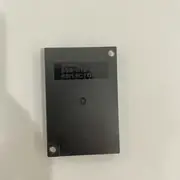
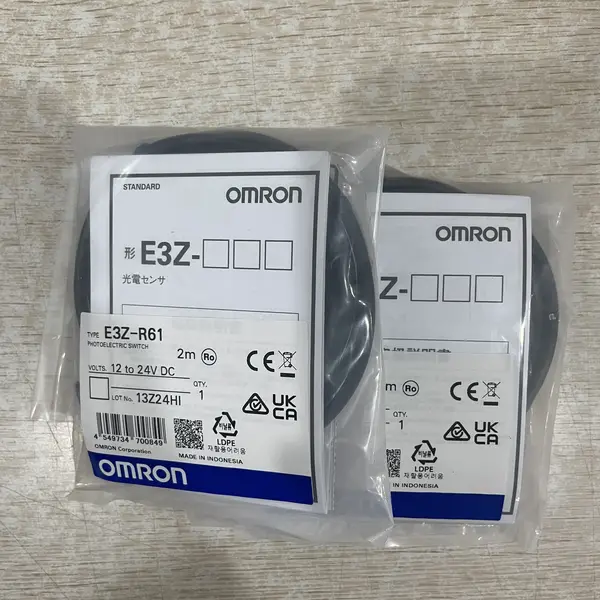
Omron E3Z-R61 2M — Retro-Reflective 4 m NPN, Pre-Wired 2 m
SKU: E3Z-R61 2MUSD 22.00
Compact retro-reflective photoelectric sensor with polarized MSR (mirror-surface rejection), 100 mm to 4 m range with E39-R1S reflector, red LED 660 nm visible spot, NPN open-collector output, pre-wired 2 m oil-resistant PVC cable, IP67, Dark-ON/Light-ON selectable.
1-Year Warranty
Full manufacturer warranty
Global Shipping
Worldwide delivery available
Genuine Omron
100% authentic product
Ready to Ship
Usually ships within 24h
In Stock
This item is available for immediate shipment from our warehouse.
Contact for pricing, bulk discounts, and shipping
Product Overview
The E3Z-R61 2M is Omron's compact retro-reflective photoelectric sensor in the E3Z family, designed for detecting opaque objects at ranges up to 4 m without the wiring complexity of a separate emitter + receiver pair. The sensor emits a red LED (660 nm) beam toward a reflector (sold separately, typically the E39-R1S), and detects when an object passes between the sensor and the reflector, breaking the beam.
Retro-reflective vs diffuse-reflective vs through-beam
The three main photoelectric sensing modes each have their niche: - Diffuse-reflective (E3Z-D61, E3Z-D62, E3Z-D81, E3Z-D82) — sensor detects light scattered back from the target itself. Range 100 mm to 1 m. No reflector needed. Range depends on target colour; black / matte targets reduce range significantly. Right pick for short-range proximity sensing. - Retro-reflective (E3Z-R61 2M, E3Z-R81, E3Z-R66, E3Z-R86) — sensor and reflector on opposite sides of the detection zone; sensor detects light returning from the reflector. Range up to 4 m. Range is independent of target colour (as long as the target is opaque).
MSR (Mirror Surface Rejection) polarization filter
The E3Z-R61 2M includes a built-in polarization filter that rejects light reflected from shiny surfaces (foil, glass, polished metal, mirror-finish aluminum). Without the filter, the sensor's red LED light would reflect off a shiny surface and return to the receiver just like the reflector — causing a false trigger. The polarization filter ensures that only the light reflected from the dedicated reflector (which depolarizes the light via its retroreflective corner-cube geometry) passes through to the receiver. This allows the E3Z-R61 2M to reliably detect shiny objects (aluminum cans, foil-wrapped packages, glossy cardboard boxes) without false triggers from their reflections.
Reflector selection and alignment
The E3Z-R61 2M requires a reflector, sold separately. For the maximum 4 m range, use the E39-R1S (60 × 40 mm compact reflector) — the standard pick for most applications. For 3 m range, use the E39-R1 (60 × 40 mm without polarization rejection). For longer range on small targets, use the E39-R7 (80 × 80 mm large reflector) for stability. For transparent-object detection (clear glass, clear PET), use the E39-R8 (special reflector with smaller cube geometry). The minimum sensor-to-reflector distance is 100 mm — closer than this, the direct LED reflection from the reflector saturates the receiver.
Key Features
- Compact retro-reflective photoelectric sensor in 20 × 11 × 31 mm cuboid housing
- Sensing distance: 100 mm to 4 m with E39-R1S reflector
- Sensing distance: 100 mm to 3 m with E39-R1 reflector
- Light source: Red LED — visible red spot for easy alignment
- MSR polarization filter — rejects false triggers from shiny surfaces
- Response time: 1 ms max
- Output: NPN open-collector, 100 mA max load current
- Dark-ON / Light-ON mode selectable via white wire
- SKU: E3Z-R61 2M
- Series: E3Z Compact Photoelectric Sensor with Built-in Amplifier
- Voltage: 12 TO 24 VDC
- I/O: 100 I/O
Best-Fit Applications
- Package detection on a wide conveyor belt — the E3Z-R61 2M and reflector are mounted on opposite sides of the.
- Bottle counting on a bottling line — the E3Z-R61 2M detects each bottle as it passes through the beam, with.
- Pallet presence detection at an AS/RS pick station — the E3Z-R61 2M detects when a pallet is in position at.
- Vehicle detection at a parking barrier / gate — the E3Z-R61 2M detects when a vehicle arrives at the barrier.
Buying Checklist
- Pick E3Z-R61 2M for 4 m retro-reflective, NPN, pre-wired 2 m — medium-range conveyor detection with MSR polarization
- Pick E3Z-R81 for 4 m retro-reflective PNP, pre-wired 2 m — same range as R61 but PNP output for European wiring standard
- Pick E3Z-R66 for 4 m retro-reflective NPN with M8 connector — quick-disconnect for modular tooling
- Pick E3Z-R86 for 4 m retro-reflective PNP with M8 connector — PNP + M8 connector
- Pick E3Z-D61 for 100 mm diffuse-reflective NPN — short-range without reflector, target must be in 100 mm range
- Pick E3Z-D62 for 1 m diffuse-reflective NPN — medium-range without reflector
Technical Specifications
| Model | E3Z-R61 2M |
|---|---|
| Series | E3Z Compact Photoelectric Sensor with Built-in Amplifier |
| Type | Retro-reflective with MSR (mirror-surface rejection), 4 m range, NPN, pre-wired |
| Sensing Method | Retro-reflective (sensor + reflector; target breaks the beam) |
| Sensing Distance (with E39-R1S reflector) | 100 mm to 4 m |
| Sensing Distance (with E39-R1 reflector) | 100 mm to 3 m |
| Light Source | Red LED (660 nm), 4-element; visible spot for alignment |
| MSR Function | Yes (built-in polarization filter rejects false triggers from shiny surfaces) |
| Output Type | NPN open-collector, 100 mA max load current |
| Output Operation Mode | Dark-ON / Light-ON selectable (via white wire connection) |
| Supply Voltage | 12 to 24 VDC ±10% (ripple 10% p-p max) |
| Current Consumption | 30 mA max |
| Operating Temperature | -25 to +55 °C |
| Storage Temperature | -40 to +70 °C |
| Mounting | 2 × M3 screws on housing flanges, or 1 × M3 through-bolt; optional E39-L40 L-bracket |
Resources & Downloads
FAQ for E3Z-R61 2M
What's the difference between E3Z-R61 2M and E3Z-D61?
Both are compact NPN-output photoelectric sensors in the E3Z family with the same 20 × 11 × 31 mm cuboid housing. The difference is the sensing mode and range: E3Z-D61 is diffuse-reflective with 100 mm range (no reflector needed, sensor detects light scattered back from the target), E3Z-R61 2M is retro-reflective with 4 m range (requires a reflector, sensor detects when the beam is broken by the target).
What reflector do I need for the E3Z-R61 2M?
The E3Z-R61 2M requires a reflector, sold separately. The standard pick for the full 4 m range is the E39-R1S (60 × 40 mm compact reflector with polarization retention) — the recommended choice for most applications. For 3 m range, use the E39-R1 (60 × 40 mm without polarization retention). For longer range with better stability on small targets, use the E39-R7 (80 × 80 mm large reflector).
How does the MSR (Mirror Surface Rejection) function work on the E3Z-R61 2M?
The MSR function uses a polarization filter on the receiver that only passes light with a specific polarization orientation. The sensor's red LED emits randomly-polarized light. When the light reflects off a retroreflective reflector (like the E39-R1S), the corner-cube geometry of the reflector depolarizes the light, rotating the polarization by 90° — so the light returning from the reflector has the opposite polarization to the original. The MSR filter passes this depolarized light through to the receiver.
Can the E3Z-R61 2M detect clear glass or PET bottles?
The E3Z-R61 2M with the standard E39-R1S reflector can detect clear glass and PET bottles, but the sensing distance is significantly reduced (typically to 1-2 m instead of 4 m, because clear materials only partially block the beam). For reliable transparent-object detection at the full 4 m range, use the E3S-DBN21 (already done in our catalog) — a specialized retro-reflective sensor with P-opaquing algorithm and a smaller reflector (E39-R8) optimized for transparent materials.
Similar Products
Explore related Omron models often viewed alongside this product.